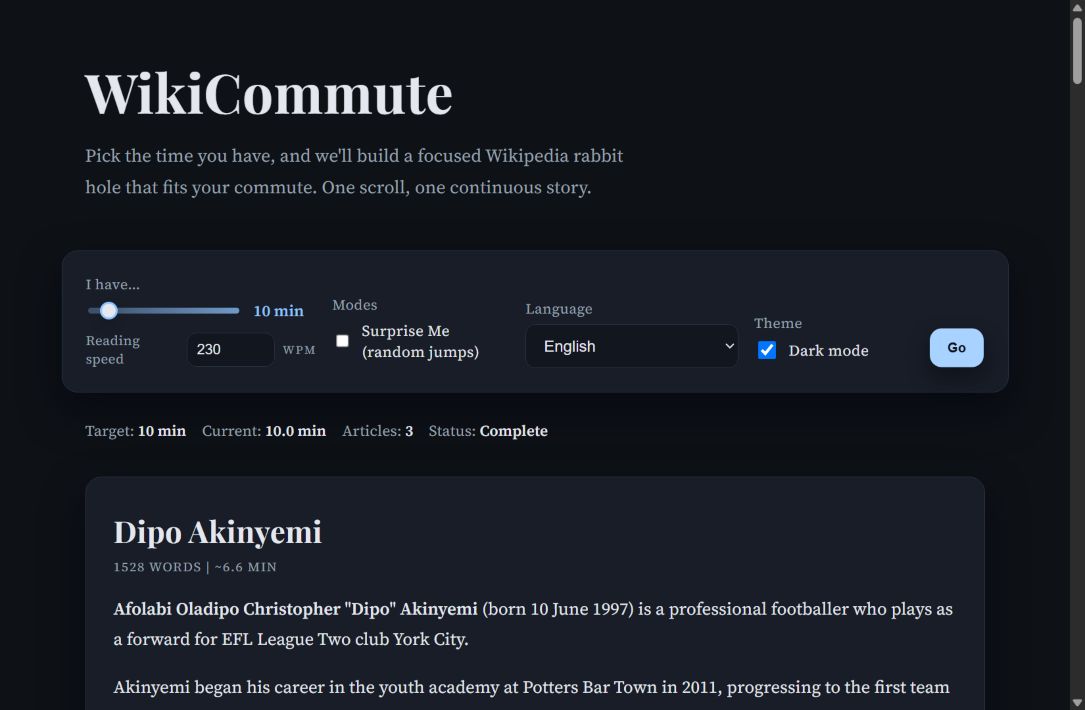
WikiCommute
“Seeing a lot of stuff built on Wikipedia at the moment, which is honestly very pleasing (it might also remind people that it’s a public good worth contributing to, financially if not temporally, because, well, it is!) – this is the latest iteration, a smart little toy which, if you give it the amount of time you’re going to be commuting for, will provide you with an Interesting Selection Of Wikipedia Bits to read, which should fit perfectly(ish) to the duration of your journey. So if rather than scrolling endlessly through Reels or placing your soul through the meatgrinder that is ‘the news’, why not instead let this take you on a fun (if seemingly entirely disconnected) selection of WikiRabbitholes.”
“I have long thought that ‘temporally-limited experiences based on journey length’ is an underexplored area of digital creativity, and this has reminded me of that (and why it is still true).”
More on WikiCommute 5 sources
“WIKIPEIA WHILST DRIVING – This site asks how much time you have to waste, and will build a Wikipedia rabbit hole with that approximate reading time for you to waste it in. Would be a good thing to replace any bottomless scroll with a specified time, really. Instead of deliberately making people addicts.”
“Tell it how long your commute is and it builds a Wikipedia rabbit hole sized to fit. One continuous scroll instead of twenty tabs you’ll abandon at your stop. There’s a ‘Surprise Me’ mode and fifteen languages, and it cites its CC BY-SA source like a good citizen. Whether the chain actually reads as one story or just vaguely adjacent topics is the part I haven’t tested, but time-boxing the spiral instead of fighting it is a neat inversion.”
“Yolculuk süreni giriyorsun, araç sana tam o süreye uygun uzunlukta Wikipedia makaleleri öneriyor. Reels kaydırmak yerine işe/okula giderken okunabilir, süreye göre ayarlanmış bir ‘mini okuma listesi’ sunumu.”
You enter your journey time and it suggests Wikipedia articles exactly that long. Instead of scrolling Reels on the way to work or school, a mini reading list tuned to the time you have.
“Hand aufs Herz: Wie oft scrollen Sie auf dem Arbeitsweg durch Feeds, ohne hinterher etwas behalten zu haben? WikiCommute dreht dieses Muster um und macht aus toter Pendelzeit eine geschlossene Leseeinheit.”
“Klassische Wikipedia-Sessions enden im Klick-Labyrinth: Ein Artikel führt zum nächsten, und nach zwanzig Minuten landen Sie bei einem Thema, das mit dem Start nichts mehr zu tun hat. WikiCommute setzt davor eine Zeitgrenze.”
Hand on heart: how often do you scroll feeds on the way to work without retaining anything? WikiCommute reverses that and turns dead commuting time into a self-contained reading unit. Classic Wikipedia sessions end in a click-labyrinth, one article leading to the next until after twenty minutes you land on something with nothing to do with where you started. WikiCommute puts a time limit in front of that.
“WikiCommute for tailored Wikipedia reading paths based on how much time you have.”
Krautreporter sent more readers than every Reddit link combined. The tool also appeared in Stephanie Walter’s Pixels of the Week, Sidebar and Dense Discovery. A French write-up credited medianes.org for finding it first; Portuguese and Spanish mentions followed too.